5 Steps to Set Up Real-Time AWS Spend Alerts


AWS bills can escalate quickly, but real-time spend alerts can help you control costs effectively. These alerts notify you about unexpected spikes, giving you the chance to act before costs get out of hand. Here's how to set them up:
- Enable Billing Alerts: Turn on "Receive CloudWatch Billing Alerts" in the AWS Billing console to track spending in real-time.
- Set Up AWS Budgets: Create budgets with thresholds for actual and forecasted costs, and configure notifications to stay informed.
- Create CloudWatch Billing Alarms: Use alarms for near real-time alerts when spending exceeds specific thresholds.
- Configure Amazon SNS: Set up SNS topics to deliver alerts to email, Slack, or other platforms.
- Enable Cost Anomaly Detection: Use AWS’s machine learning tools to catch unusual spending patterns.
These tools work best together, providing both real-time alerts and insights into spending trends. For deeper cost savings, platforms like Opsima can optimize your AWS usage automatically. You can also compare AWS regional pricing to find further savings. Start managing your cloud costs today!

AWS Cost Monitoring Tools Comparison: CloudWatch Alarms vs AWS Budgets vs Cost Anomaly Detection
Step 1: Enable Billing Alerts and Cost Visibility
Turn On Billing Metrics in AWS

To get started, head over to the AWS Billing and Cost Management console and go to Billing Preferences. There, check the option labeled "Receive CloudWatch Billing Alerts". This enables AWS to send periodic updates about your estimated charges directly to CloudWatch.
Keep in mind that it may take 15–30 minutes for the billing data to show up in CloudWatch. Once the data is available, switch your AWS Management Console region to US East (N. Virginia). This is important because billing metrics are only stored in this region. After switching, you can confirm that the "Billing" namespace is visible in your CloudWatch metrics.
If you're using AWS Organizations, make sure to enable this feature in the management (payer) account. This ensures billing data from all linked accounts is captured. However, note that accounts in the Amazon Partner Network won't have access to billing metrics.
Now, let’s look at how these metrics help you understand your costs.
Understanding Cost Visibility in USD
CloudWatch billing metrics present all costs in US dollars (USD). These metrics show your current usage costs for the ongoing billing cycle. They are not forecasts of future spending but rather a running total of what you've used so far. The data is updated several times a day and stored for a rolling 14-day period.
"The estimate approximates the cost of your AWS usage to date within the current billing cycle and will increase as you continue to consume resources." - Jeff Barr, Chief Evangelist, AWS
Keep in mind that these estimates might not match your final invoice exactly. Variations can occur due to factors like rounding, discounts, or timing differences in data reporting.
Step 2: Set Up AWS Budgets for Threshold Alerts
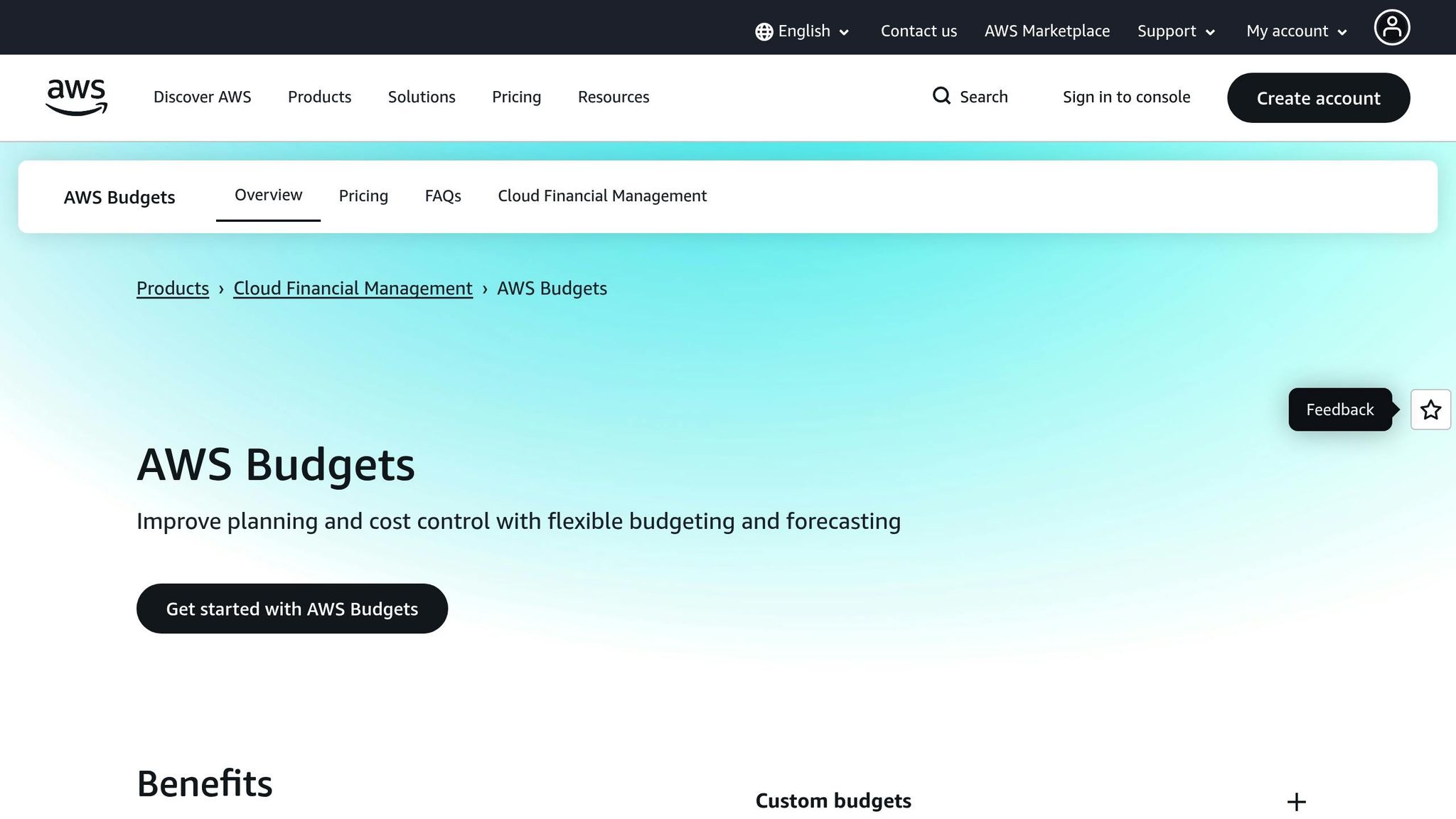
Create a Cost Budget in AWS
To get started, head over to the AWS Budgets section in the Billing and Cost Management console. You’ll have two options: a simplified template for quick setup or an advanced custom option for more tailored tracking. The custom option is ideal if you need to monitor specific costs with greater precision.
Give your budget a name that reflects the service or project you’re monitoring. Then, select a budget period - Daily, Monthly, Quarterly, Annually, or Custom. The Custom option is especially handy for aligning budgets with non-standard timelines, like a fiscal year or specific project duration.
Next, decide how you want to set your budget amount:
- Fixed: Set a static amount (e.g., $5,000/month).
- Planned: Use variable amounts for different periods.
- Auto-adjusting: Let AWS adapt the budget based on your historical spending trends.
For renewal, choose Recurring to ensure your budget automatically resets without any gaps. If you’ve made upfront payments for Reserved Instances or Savings Plans, selecting Amortized costs for cost aggregation will spread those expenses evenly over their term. Note: AWS automatically enables Cost Explorer if it’s not already active.
Finally, set thresholds and configure notifications to alert you when spending approaches or exceeds your limits.
Configure Alert Thresholds and Notifications
Once your budget is set, it’s time to define thresholds that will help you keep spending under control. These thresholds can be based on either a specific dollar amount (e.g., $1,000) or a percentage (e.g., 80%). You can also choose to monitor Actual spend (costs already incurred) or Forecasted spend (predicted costs for the period).
"Actual alerts are only sent out once per budget, per budget period, when a budget first reached the actual alert threshold." – AWS Documentation
For effective monitoring, set up three alerts:
- 80% of actual spend: A heads-up that you’re nearing your limit.
- 100% of actual spend: Indicates you’ve hit your budget.
- 100% of forecasted spend: Alerts you if AWS predicts you’ll exceed your budget by the end of the period.
Keep in mind, forecast-based alerts require at least five weeks of historical data to function. Each alert can notify up to 10 email addresses and one Amazon SNS topic. If you’re using SNS, make sure recipients confirm their subscription via the AWS confirmation email to ensure they receive the alerts.
AWS updates budget data one to three times daily (usually every 8–12 hours), so alerts will follow this update cycle.
Budget Alert Types Compared
| Alert Type | Actual Spend | Forecasted Spend |
|---|---|---|
| When It Triggers | When incurred costs reach your set threshold | When AWS predicts costs will exceed your threshold by period end |
| Alert Frequency | Once per threshold per period | May trigger multiple times if the forecast fluctuates |
| Data Requirements | Available immediately | Requires approximately 5 weeks of historical data |
| Best For | Hard budget enforcement and emergency notifications | Early-month course correction and financial planning |
AWS offers a Free Tier benefit where your first two budgets (covering up to 60 budget days per month) are free. Additional budgets cost $0.02 per day.
Step 3: Create CloudWatch Billing Alarms
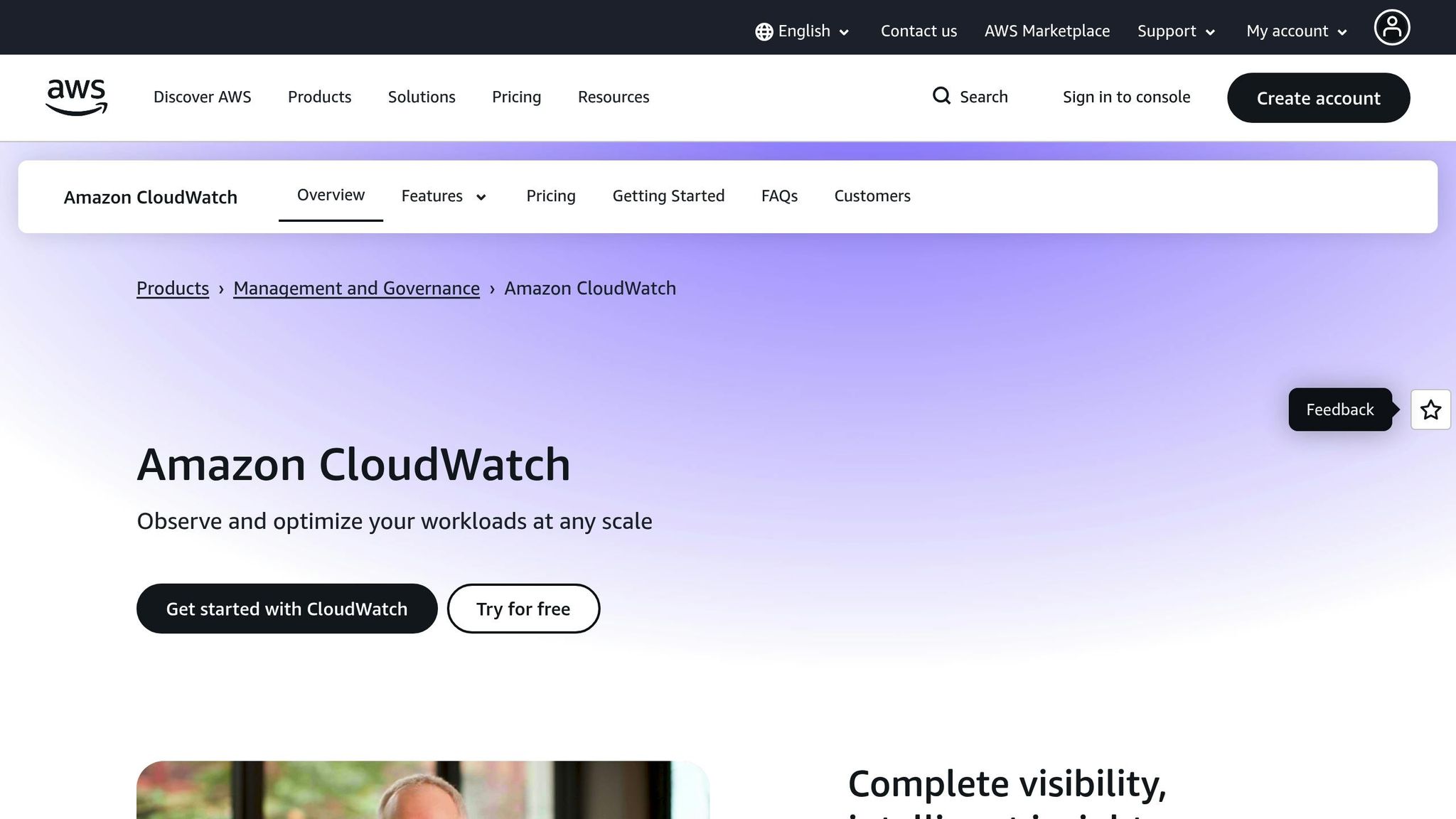
Set Up a CloudWatch Billing Alarm
After enabling billing metrics, the next step is setting up CloudWatch billing alarms. Remember, you must switch to the US East (N. Virginia) Region (us-east-1) in the AWS Management Console to create or view these alarms. This region is necessary due to how billing data is processed.
Start by opening the CloudWatch console. Navigate to Alarms and click on Create Alarm. From the AWS/Billing namespace, choose the EstimatedCharges metric, which represents your total estimated charges for the current billing cycle in USD. Set the Statistic to "Maximum" and the Period to "6 hours" since billing data is updated approximately every six hours.
Next, define a static threshold above your desired limit (e.g., $200). For immediate alerts, set "Datapoints to alarm" to 1 out of 1 - this ensures the alarm triggers as soon as any single 6-hour evaluation period surpasses your threshold. To receive notifications, link the alarm to an SNS topic (discussed in Step 4).
"The alarm triggers when your account billing exceeds the threshold you specify. It triggers only when the current billing exceeds the threshold. It doesn't use projections based on your usage so far in the month." – Amazon CloudWatch Documentation
It’s a good idea to set up multiple alarms at various thresholds - like $100, $500, and $1,000 - so you can monitor your costs progressively throughout the month. CloudWatch retains billing metric data for 14 days, allowing you to review historical trends and alarm activity. Keep in mind that creating CloudWatch alarms incurs charges at standard AWS rates.
These alarms work well alongside AWS Budgets, adding another layer to your FinOps maturity journey.
CloudWatch Alarms vs AWS Budgets
While both CloudWatch billing alarms and AWS Budgets help monitor costs, they serve different purposes. CloudWatch alarms focus on near real-time monitoring, evaluating your spending every six hours and triggering alerts as soon as you exceed a threshold. They’re quick to set up if you’re familiar with the process.
On the other hand, AWS Budgets offers predictive capabilities that CloudWatch lacks. Budgets can forecast whether your spending will exceed a limit by the end of the month based on your usage trends. Additionally, Budgets can automate actions, like applying IAM policies or stopping EC2 instances, when thresholds are reached - features CloudWatch doesn’t offer.
| Feature | CloudWatch Billing Alarms | AWS Budgets |
|---|---|---|
| Evaluation Frequency | Approximately every 6 hours | 1-3 times daily (8-12 hour intervals) |
| Alert Basis | Actual spend only | Actual and forecasted spend |
| Setup Effort | Moderate (requires SNS setup and region selection) | Low (uses simplified templates) |
| Best For | Near real-time monitoring | Long-term tracking and forecasting |
For the best results, using both tools together is ideal. CloudWatch provides immediate alerts for threshold breaches, while AWS Budgets offers a broader view with forecasting and automated responses. Combining these tools ensures both real-time monitoring and strategic cost planning.
Step 4: Configure Amazon SNS for Alert Notifications
Create an SNS Topic for Spend Alerts
Amazon SNS is the service that ensures your spend alerts reach email addresses or other endpoints. Without it, tools like CloudWatch alarms and AWS Budgets won't notify you (unlike native tool alternatives) when thresholds are crossed.
To get started, open the Amazon SNS console and go to Topics > Create topic. Choose the "Standard" topic type, which works for most alert scenarios. If you're setting this up for CloudWatch billing alarms, make sure to create the topic in the US East (N. Virginia) region since billing metrics are stored there. For AWS Budgets, the topic must be in the same account as the budget because cross-account notifications aren't supported.
Once your topic is created, you'll need to grant AWS billing services permission to publish messages to it. Select the topic, go to the Access policy tab, and choose Advanced. Add a policy statement that allows the relevant service principal - like budgets.amazonaws.com for AWS Budgets or costalerts.amazonaws.com for Cost Anomaly Detection - to use the SNS:Publish action. To enhance security and prevent unauthorized access (known as "confused deputy" risks), include conditions like aws:SourceAccount and aws:SourceArn in your policy.
Next, create a subscription by selecting Email as the protocol and entering the recipient's email address. AWS will send a confirmation email to that address, and the recipient must click the Confirm subscription link before alerts can be delivered. After setting up the subscription, check its status - if it shows "PendingConfirmation", the recipient hasn't confirmed yet. Keep in mind that a single budget notification can be sent to a maximum of 10 email addresses.
If you enable server-side encryption (SSE) for your SNS topic, update your AWS KMS key policy to allow billing services to perform actions like kms:GenerateDataKey* and kms:Decrypt. Finally, copy the Topic ARN and paste it into your AWS Budgets or CloudWatch Alarm configuration. This setup forms the backbone for more advanced integrations.
Connect SNS to Other Systems
Once your SNS topic is configured, you can expand its functionality by linking it to automation tools or chat platforms. With multiple subscriptions possible for a single SNS topic, you can send spend alerts to an email list, trigger a Lambda function, and post updates to a Slack channel - all at the same time.
For chat integrations, Amazon Q Developer (formerly AWS Chatbot) can route SNS notifications directly to platforms like Amazon Chime, Microsoft Teams, or Slack. Simply copy the Webhook URL from your chat platform's settings and paste it into the Amazon Q Developer console. Use the Notification permissions IAM policy template to grant the necessary Read and List permissions for SNS topics and CloudWatch alarms. Be aware that enabling logging for these chat integrations may incur additional charges for Amazon CloudWatch Logs.
To automate responses, connect your SNS topic to an AWS Lambda function. Lambda can run custom code, allowing you to forward billing data to external APIs or trigger cost-control measures automatically. If you're working with systems not directly supported by Amazon Q Developer, a Lambda function can process the SNS message and forward it to a custom webhook. Plus, Amazon SNS offers 1 million requests free per month under the AWS Free Tier, so experimenting with these integrations won't immediately increase your costs.
Step 5: Enable Cost Anomaly Detection
Configure Cost Anomaly Detection
AWS Cost Anomaly Detection uses machine learning to identify unexpected spending patterns that traditional fixed budgets might miss. To get started, enable AWS Cost Explorer, which will generate 13 months of historical data and spending forecasts automatically. By default, the system creates an "AWS services monitor" and sets up a daily summary alert that triggers if an anomaly exceeds $100 or 40% of the expected spend.
There are two types of monitors available:
- AWS Managed Monitors: These automatically track all services, member accounts, cost allocation tags, or cost categories. They adjust to changes in your environment and can monitor up to 5,000 values.
- Customer Managed Monitors: These allow you to track up to 10 specific values, offering more precise control.
For most FinOps teams, managed monitors are the better choice since they automatically include new accounts or tags without requiring manual updates.
When setting up alert subscriptions, you can use a combination of absolute thresholds (e.g., exceeding $1,000) and percentage increases (e.g., over 50%) to filter out minor fluctuations. Configure alerts to send notifications via an SNS topic, which can integrate with tools like Slack or Microsoft Teams for real-time updates. The system evaluates data three times daily, though anomaly detection may take up to 24 hours. Additionally, new services require at least 10 days of historical data for accurate monitoring.
Once anomalies are detected, AWS provides automated root cause analysis, identifying the top spend drivers across four dimensions: AWS Service, AWS Account, Region, and Usage Type. To improve the accuracy of the detection model, mark anomalies as either "Accurate" or "Not an issue" using the "Submit assessment" feature.
This system works alongside your existing spending alerts, offering a way to catch subtle cost discrepancies that fixed thresholds might overlook.
Anomaly Detection vs Fixed Thresholds
Understanding the differences between anomaly-based alerts and fixed thresholds can help you choose the right approach for your environment.
The main distinction lies in flexibility. Fixed thresholds trigger alerts as soon as a predefined limit is reached, regardless of the context. Anomaly detection, on the other hand, accounts for patterns like seasonal variations - such as higher usage on weekdays - or spikes at specific times, like the start of a month. This reduces false positives that often occur with fixed thresholds during natural usage changes.
| Feature | Fixed Threshold Alerts (AWS Budgets) | Anomaly-Based Alerts (Cost Anomaly Detection) |
|---|---|---|
| Setup Effort | Manual; requires setting specific budget limits for each category. | Minimal; managed monitors automatically track and adjust to new resources. |
| Sensitivity | Static; alerts trigger only when a hard limit is reached. | Adaptive; uses machine learning to account for seasonal trends and organic growth. |
| Best Scenarios | Ideal for known spending limits, monthly caps, and predictable workloads. | Best for spotting unexpected spikes or cost surges in complex environments. |
| Threshold Type | User-defined fixed dollar or percentage amounts. | ML-based "expected spend" compared to actual spend, with user-defined impact thresholds. |
| Maintenance | High; thresholds need frequent updates as workloads or budgets change. | Low; managed monitors automatically adapt as new accounts and services are added. |
Fixed thresholds work well for strict monthly or quarterly budget caps. However, anomaly detection is better suited for dynamic environments, seasonal workloads, or catching unexpected cost spikes due to misconfigurations. By combining both methods, you can maintain spending discipline while uncovering unusual patterns that might otherwise slip through the cracks. For more FinOps insights on managing cloud spend, explore our expert guides.
Conclusion: Using Spend Alerts for Cost Optimization
Add Alerts to Your Cost Management Workflow
Integrating real-time spend alerts into your workflow can help teams act promptly when costs start to climb. Assign specific alerts to the appropriate teams - for instance, route technical alerts to your IT department and send summary reports to finance teams for better coordination.
Create a structured response plan: raise awareness when spending hits 50%, initiate a detailed review at 80%, and implement cost controls once it reaches 100%. To refine this process, review historical alerts and utilize tools like AWS Cost Anomaly Detection to identify recurring spending spikes, whether they're tied to specific services, accounts, regions, or usage types. Marking anomalies improves the detection model over time.
Set up recurring monthly or quarterly budgets to ensure continuous monitoring. For organizations using consolidated billing, enable "Receive Billing Alerts" in the management account to capture data from all linked accounts. Keep in mind that AWS Budgets refreshes its data 1–3 times daily, with updates occurring every 8–12 hours.
By combining alert-based actions with automated cost optimization, you can build a more robust approach to managing cloud expenses.
How Opsima Works with Spend Alerts
Spend alerts are great for flagging immediate cost increases, but Opsima takes things a step further by focusing on long-term cost reduction. While AWS alerts notify you of spending thresholds, they don’t directly lower your expenses. Opsima, on the other hand, continuously adjusts your resource commitments - like Savings Plans and Reserved Instances - to secure better rates. This proactive approach can cut costs by up to 40% without requiring any changes to your infrastructure.
Think of it this way: spend alerts tell you when costs are rising, but Opsima helps you understand why and takes action to optimize your spending as your needs change. It supports major AWS services like EC2, RDS, and Lambda, and operates on a pay-as-you-save model, charging only a small percentage of the savings achieved. With a quick 15-minute onboarding process and the flexibility to cancel at any time, Opsima integrates seamlessly into your existing workflow while maintaining the adaptability your team values.
AWS Budgets Tutorial - Setup Alerts for AWS Billing | Amazon Web Services
After watching the tutorial, you can estimate your AWS savings to see how much you could reduce your monthly bill.
FAQs
How can I set up AWS spend alerts to notify me through Slack or email?
To keep track of your AWS spending and receive alerts through Slack or email, you’ll need to connect a budget or CloudWatch billing alarm to an Amazon SNS topic. From there, you can route notifications to your preferred platform - either Slack or email.
Here’s how you can set it up:
- Create a budget or billing alarm: In the AWS Billing and Cost Management console or CloudWatch, define a spending threshold (like $1,000). This threshold will trigger an alert whenever your costs exceed the set limit.
-
Set up an Amazon SNS topic: Link your budget or alarm to an SNS topic. If one doesn’t exist, create a new topic (e.g.,
aws-spend-alerts). - Add email recipients: Subscribe email addresses to the SNS topic for direct email notifications. Recipients will need to confirm their subscription to start receiving alerts.
- Enable Slack notifications: To route alerts to Slack, use AWS Chatbot. Connect the SNS topic to your Slack workspace, authorize it, and select the channel where you want notifications to appear.
Once everything is set up, test the system by either triggering an alert manually or waiting for the next billing update. This way, you’ll always stay informed about your AWS costs and avoid unexpected surprises.
What’s the difference between AWS CloudWatch Alarms and AWS Budgets for cost monitoring?
AWS CloudWatch Alarms and AWS Budgets are both cost-monitoring tools, but they cater to different needs.
CloudWatch Alarms track your actual spending by using the estimated-charges metric, which updates multiple times a day. When your spending crosses a predefined threshold, these alarms send immediate notifications through Amazon SNS, such as email or SMS. This makes them perfect for keeping a close, real-time eye on your expenses.
AWS Budgets, on the other hand, offer a more flexible approach to managing costs. With Budgets, you can set cost or usage limits that are either fixed or adjustable. They let you track both actual spending and forecasted expenses, and even automate actions like limiting resource provisioning when you’re nearing your budget. Notifications can also be sent via email or SNS, and you can customize the reset intervals - monthly, quarterly, or whatever suits your needs.
In short, CloudWatch Alarms are great for immediate, real-time alerts on spending, while AWS Budgets provide a more detailed approach with forecasting and automated controls. Both tools are valuable for managing costs, and Opsima’s platform can integrate with them to offer real-time notifications and proactive cost management.
How does AWS Cost Anomaly Detection improve spending alerts?
AWS Cost Anomaly Detection takes the hassle out of tracking unexpected spending by leveraging machine learning to spot unusual cost patterns automatically. Instead of relying on static limits, it uses dynamic thresholds that adjust based on your usage, reducing the need for constant manual tweaking.
With this service, you’ll get detailed alerts delivered straight to your email, Amazon SNS, or even chat platforms. These notifications give you a heads-up on unexpected expenses, covering all your AWS accounts, services, and tags. It’s a smarter way to stay on top of your costs without the extra effort.