S3 Storage Classes: Durability Comparison

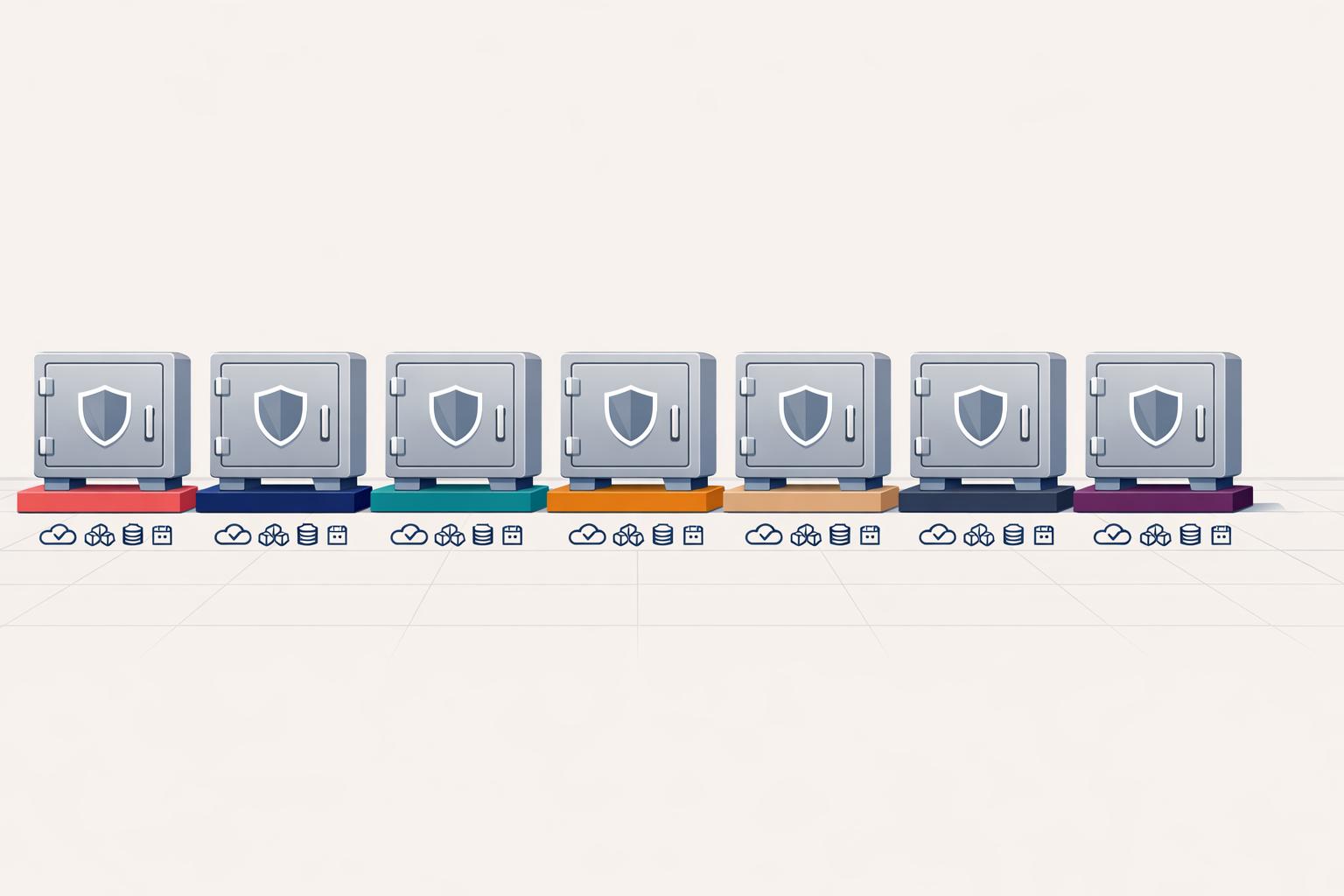
Amazon S3 storage classes all offer 99.999999999% (11 nines) durability, ensuring your data is protected from loss. However, they differ in availability, redundancy, and cost, making each suited to specific use cases. Here's a quick breakdown:
- S3 Standard: Best for frequently accessed data, with 99.99% availability and no retrieval fees. Costs ~$0.023/GB.
- S3 Intelligent-Tiering: Automatically moves data to cost-efficient tiers based on usage. Includes a monitoring fee (~$0.0025/1,000 objects).
- S3 Standard-IA: Lower cost (~$0.0125/GB), ideal for infrequently accessed data. Includes retrieval fees and a 30-day minimum storage requirement.
- S3 One Zone-IA: Stores data in one Availability Zone, reducing costs (~$0.01/GB) but increasing risks during AZ outages.
- S3 Glacier Instant Retrieval: Low-cost archival storage (~$0.004/GB) with millisecond access. Suitable for rarely accessed data.
- S3 Glacier Flexible Retrieval: Cheaper (~$0.0036/GB) for long-term archives where retrieval can take hours.
- S3 Glacier Deep Archive: Lowest-cost option (~$0.00099/GB) for ultra-long-term storage, with retrieval times of 12–48 hours.
Key Takeaways:
- All classes provide 11 nines durability.
- Costs decrease with less frequent access but may include retrieval fees and minimum storage durations.
- Multi-AZ redundancy protects data from regional disasters, except for S3 One Zone-IA.
Quick Comparison:
| Storage Class | Durability | Availability | Redundancy | Cost (per GB) | Best For |
|---|---|---|---|---|---|
| S3 Standard | 99.999999999% | 99.99% | Multi-AZ | ~$0.023 | Frequently accessed, critical data |
| S3 Intelligent-Tiering | 99.999999999% | 99.9% | Multi-AZ | Variable + ~$0.0025 monitoring fee | Unpredictable access patterns |
| S3 Standard-IA | 99.999999999% | 99.9% | Multi-AZ | ~$0.0125 | Infrequently accessed, immediate retrieval |
| S3 One Zone-IA | 99.999999999% | 99.5% | Single AZ | ~$0.01 | Reproducible data, cost savings |
| S3 Glacier Instant Retrieval | 99.999999999% | 99.9% | Multi-AZ | ~$0.004 | Rarely accessed, instant retrieval |
| S3 Glacier Flexible Retrieval | 99.999999999% | 99.99%* | Multi-AZ | ~$0.0036 | Long-term archives, slower retrieval |
| S3 Glacier Deep Archive | 99.999999999% | 99.99%* | Multi-AZ | ~$0.00099 | Ultra-long-term storage, rare access |
*Availability applies after object restoration.
Choose based on your data's access frequency, availability needs, and risk tolerance.

AWS S3 Storage Classes Comparison: Durability, Availability, Cost and Features
1. S3 Standard
Durability
Amazon S3 Standard is built to deliver an impressive 99.999999999% durability - that’s 11 nines! This level of durability is made possible through continuous checksum verification and quick fault detection mechanisms. These processes ensure your data remains safe and intact, even at massive scales.
Availability
When it comes to availability, S3 Standard ensures 99.99% uptime, which translates to less than 52 minutes of downtime per year. For added peace of mind, Amazon also backs this with a Service Level Agreement (SLA) guaranteeing 99.9% availability. If this threshold isn’t met, monetary compensation is provided. This makes S3 Standard a great choice for applications that need consistent performance, such as websites, real-time analytics, or content delivery platforms.
AZ Redundancy
To safeguard your data, S3 Standard stores it redundantly across at least three separate Availability Zones (AZs). These AZs are physically isolated and can be up to 60 miles apart, offering strong protection against localized disasters. Even if an entire AZ goes offline, the system is designed to automatically restore lost redundancy without any impact on your data.
Cost Efficiency
S3 Standard is designed with flexibility in mind, particularly for frequently accessed data. It avoids additional charges like retrieval fees, minimum storage durations, or penalties for object size. While its per-gigabyte storage cost is higher compared to Infrequent Access classes, it becomes more economical for data accessed multiple times a month. You only pay for the actual storage time, and you can delete or transition objects at any point without extra fees.
2. S3 Intelligent-Tiering
Durability
S3 Intelligent-Tiering delivers impressive durability, offering 11 nines (99.999999999%) by replicating data across three separate Availability Zones, just like S3 Standard. This ensures your data remains safe and secure, even under extreme circumstances.
In addition to this level of durability, S3 Intelligent-Tiering also provides strong availability for seamless access to your data.
Availability
This storage class guarantees 99.9% annual availability, backed by a 99% SLA guarantee. What's more, it automatically moves data between access tiers based on usage patterns, ensuring that performance remains unaffected while optimizing costs.
These features make it a solid choice for businesses looking to balance performance with cost management strategies like commitment-based pricing.
Cost Efficiency
S3 Intelligent-Tiering combines its 11 nines durability with the ability to automatically shift data to lower-cost tiers based on usage, all without retrieval fees. This means you save on storage costs without compromising data safety. Since its introduction in 2018, this storage class has helped customers save over $6 billion in storage expenses.
The cost-saving potential is significant. For instance, tier adjustments can reduce costs by up to 68%, as demonstrated by companies like Illumina and Electronic Arts. Illumina managed to cut storage costs by 60% per terabyte within just three months, giving them near-instant access to whole genome sequences. Similarly, Electronic Arts achieved a 30% reduction in storage costs while managing tens of petabytes of data.
"S3 Intelligent-Tiering was our 'easy' button and helped us move at the speed we needed without adding development cycles." This approach aligns with broader AWS cost optimization efforts that focus on operational efficiency.
– Justin Brown, Head of Vehicle Data Acquisition, Torc Robotics
It's worth noting that objects smaller than 128 KB are not eligible for automatic tiering. This limitation is something to keep in mind when planning your storage strategy.
3. S3 Standard-IA
Durability
S3 Standard-IA provides an impressive 11 nines (99.999999999%) durability by distributing data across at least three Availability Zones. This setup ensures that your data remains intact even in the unlikely event of an entire Availability Zone failure.
Availability
This storage class guarantees 99.9% availability with a 99% SLA. While its availability is slightly lower than S3 Standard's 99.99%, it still delivers dependable millisecond access and high throughput.
"Amazon S3 Standard – IA offers the same high durability and performance as Amazon S3 Standard so we can continue to deliver the same amazing experience for our customers even as their cameras continue to shoot bigger, higher-quality photos and videos."
– Don MacAskill, CEO & Chief Geek, SmugMug
This combination of availability and durability makes it a strong choice for specific cost-saving use cases.
Cost Efficiency
S3 Standard-IA is perfect for data that isn’t accessed frequently but still needs to be retrieved immediately when required. It offers lower per-GB costs compared to S3 Standard, though retrieval fees apply. By transitioning data from S3 Standard to S3 Standard-IA, businesses can often cut storage costs by around 41%.
However, there are some key considerations:
- A 30-day minimum storage duration applies.
- Objects smaller than 128 KB are billed as though they are 128 KB.
- Early deletions (before 30 days) result in prorated charges.
These conditions make S3 Standard-IA an excellent choice for use cases like backups, disaster recovery, and long-term storage of less frequently accessed data.
"Standard – IA lets us significantly reduce storage costs on our older video objects without sacrificing durability."
– Brian Kaiser, CTO, Hudl
S3 Storage Classes Explained [DEMO]
4. S3 One Zone-IA
S3 One Zone-IA stands out by storing data in a single Availability Zone, unlike other S3 classes that spread data across multiple locations. While this approach reduces costs, it comes with an increased risk tied to zone-specific failures.
Durability
With a durability rate of 99.999999999% within one Availability Zone, S3 One Zone-IA ensures a high level of data integrity under normal conditions. However, because data is confined to a single zone, a complete failure of that zone would result in data loss.
AZ Redundancy
Unlike other storage classes that replicate data across three or more geographically separated Availability Zones, S3 One Zone-IA keeps all data in just one location. As a result, it’s not a suitable choice for critical or irreplaceable data.
"S3 One Zone-IA is just as durable from an engineering standpoint as the other storage classes except in the event that the availability zone where your data is stored is destroyed." – Michael - sqlbot, Stack Overflow
Availability
S3 One Zone-IA offers 99.5% availability, supported by a 99% SLA. However, if the Availability Zone experiences an outage, access to your data will be completely interrupted until the zone is restored.
Cost Efficiency
S3 One Zone-IA is approximately 20% cheaper than S3 Standard-IA, costing around $0.01 per GB per month. This makes it a practical choice for data that can be reproduced, such as image thumbnails, transcoded media, or secondary backups where a primary copy exists elsewhere. However, it comes with specific conditions: a 30-day minimum storage duration, a 128 KB minimum billable object size, and retrieval fees of about $0.01 per GB. While the cost savings are appealing, they come with the trade-off of relying on single-AZ storage, which carries inherent risks.
5. S3 Glacier Instant Retrieval
S3 Glacier Instant Retrieval strikes a balance between low-cost archival storage and immediate data access. It delivers the same millisecond retrieval speeds as S3 Standard but at a much lower storage cost. This makes it a great fit for data that's rarely accessed but needs to be instantly available when required.
Durability
This storage class provides an impressive 11 nines of durability, matching the reliability of S3 Standard.
AZ Redundancy
Data is stored across at least three physically separate Availability Zones (AZs). This ensures that even if one data center experiences an outage, your data remains accessible.
Availability
S3 Glacier Instant Retrieval is built for 99.9% availability and comes with a 99% Service Level Agreement. While slightly below S3 Standard's 99.99% availability, it still offers dependable access for most scenarios. This level of reliability pairs well with its cost-effective pricing structure.
Cost Efficiency
This storage class costs about $0.004 per GB per month in the US East (N. Virginia) region, which is approximately 68% cheaper than S3 Standard-IA. However, retrieval fees are higher at around $0.03 per GB - three times the cost of Standard-IA. Because of this pricing model, it's most suitable for data that’s accessed once every three months or less. For example, Canva uses S3 Glacier Instant Retrieval to manage its growing repository of user-generated designs, saving an estimated $300,000 per month, or $3.6 million annually. Keep in mind that this class requires a 90-day minimum storage duration and a minimum billable object size of 128 KB.
"Using Amazon S3 Glacier Instant Retrieval gives us the best of both worlds: instant access to data stored in an extremely cost-effective manner." – Manjor Kalyanaraman, Chief Technology Officer, Dropsuite
6. S3 Glacier Flexible Retrieval
S3 Glacier Flexible Retrieval is designed for long-term archival storage where immediate access isn't a priority. Since data retrieval requires a restoration process, it's a great fit for backups and disaster recovery situations where retrieval times range from minutes to hours.
Durability
This storage class offers 11 nines of durability (99.999999999%), matching the durability of other S3 regional classes. It continuously checks data integrity and repairs any redundancy loss, ensuring your data remains secure and intact over time.
AZ Redundancy
Data stored in S3 Glacier Flexible Retrieval is replicated across at least three separate Availability Zones within an AWS Region. This setup ensures that even if an entire Availability Zone fails, your data remains safe and accessible. Compared to single-AZ options like S3 One Zone-IA, this multi-AZ approach provides significantly stronger protection.
Availability
This storage class is designed for 99.99% annual availability and comes with a 99.9% availability Service Level Agreement (SLA). These figures exceed the availability design of S3 Standard-IA and S3 Glacier Instant Retrieval, making it a dependable option for archival storage needs.
Cost Efficiency
With a storage cost of approximately $0.0036 per GB per month, S3 Glacier Flexible Retrieval is about 84% cheaper than S3 Standard, while still maintaining the same durability and AZ redundancy. It’s also around 10% less expensive than S3 Glacier Instant Retrieval for storage.
To further manage costs, you can choose from different retrieval tiers:
- Expedited: 1–5 minutes at ~$0.03/GB
- Standard: 3–5 hours at ~$0.01/GB
- Bulk: 5–12 hours, free
However, this storage class requires a 90-day minimum storage duration and a 40 KB minimum object size. Each object also incurs a 40 KB metadata overhead (split as 32 KB at Glacier Flexible Retrieval rates and 8 KB at S3 Standard rates). To minimize costs, it’s more efficient to bundle smaller files into larger archives before uploading.
"Flexible Retrieval is the king of cost savings for true archives, but only if your Time to Recovery Service Level Agreement (SLA) allows for a delay." – Chandra, CFO, Costimizer
7. S3 Glacier Deep Archive
If you're looking to save on storage costs for ultra-long-term data, S3 Glacier Deep Archive is where affordability meets practicality. Designed with cost efficiency in mind rather than speed, it’s a great choice for data that needs to stick around for years but is rarely accessed.
S3 Glacier Deep Archive is Amazon S3's most cost-effective storage option, perfect for data you need to retain for 7–10 years. Think regulatory archives, compliance documents, or digital preservation projects. At a price of about $0.00099 per GB per month (roughly $1 per TB per month), it's up to 75% cheaper than S3 Glacier Flexible Retrieval.
Durability
With 11 nines of durability (99.999999999%), S3 Glacier Deep Archive ensures your data is safeguarded for decades. It continuously checks data integrity using checksums and automatically fixes any redundancy issues to keep your data intact, just like S3 Standard and other regional storage classes.
AZ Redundancy
Your data is stored across three or more physically separated Availability Zones (AZs) within an AWS Region. This setup protects against localized disasters and ensures that even if an entire AZ goes down, your data remains secure.
Availability
Glacier Deep Archive offers 99.99% annual availability and comes with a 99.9% availability SLA. This matches the performance of S3 Glacier Flexible Retrieval and even surpasses the availability of S3 Standard-IA and S3 One Zone-IA. If your data is rarely accessed but needs to be kept safe for the long haul, this is a solid option.
Cost Efficiency
While Glacier Deep Archive boasts the lowest storage costs in the S3 lineup, there are a few things to keep in mind:
- 180-day minimum storage duration: Deleting or overwriting data before this period ends will result in pro-rated fees.
- Metadata overhead: Each object comes with a 40 KB metadata charge (32 KB billed at Deep Archive rates and 8 KB at S3 Standard rates). To optimize costs, bundling smaller files is recommended.
- Retrieval times: Standard requests take about 12 hours, while Bulk requests may take up to 48 hours. Retrievals also incur additional per-GB and per-request fees.
"The new Glacier Deep Archive storage class is designed to provide durable and secure long-term storage for large amounts of data at a price that is competitive with off-premises tape archival services." – Jeff Barr, Vice President and Chief Evangelist, AWS
If you’re looking for a reliable and budget-friendly way to store data you don’t need to access often, this storage class delivers.
Pros and Cons
Amazon S3 storage classes balance durability, availability, cost, and access speed differently. Knowing these trade-offs helps you choose the best option for your data.
Here’s a summary of the key characteristics and trade-offs across S3 storage classes:
| Storage Class | Durability | Availability | AZ Redundancy | Storage Cost | Trade-offs |
|---|---|---|---|---|---|
| S3 Standard | 99.999999999% | 99.99% | ≥ 3 AZs | Highest (~$0.023/GB) | No retrieval fees; ideal for frequently accessed data |
| S3 Intelligent-Tiering | 99.999999999% | 99.9% | ≥ 3 AZs | Variable | Monitoring fee (~$0.0025/1,000 objects); no retrieval fees; adjusts storage tiers automatically |
| S3 Standard-IA | 99.999999999% | 99.9% | ≥ 3 AZs | Moderate (~$0.0125/GB) | 30-day minimum; $0.01/GB retrieval fee; 128 KB minimum object size |
| S3 One Zone-IA | 99.999999999% | 99.5% | 1 AZ | Lower (~$0.01/GB) | Costs 20% less than Standard-IA but lacks AZ failure resilience; suitable for reproducible data |
| S3 Glacier Instant Retrieval | 99.999999999% | 99.9% | ≥ 3 AZs | Low (~$0.004/GB) | 90-day minimum; $0.03/GB retrieval fee; up to 68% savings vs. Standard-IA for quarterly access |
| S3 Glacier Flexible Retrieval | 99.999999999% | 99.99%* | ≥ 3 AZs | Very Low | 90-day minimum; retrieval takes minutes to hours; 40 KB metadata overhead |
| S3 Glacier Deep Archive | 99.999999999% | 99.99%* | ≥ 3 AZs | Lowest (~$0.00099/GB) | 180-day minimum; 12–48 hour retrieval; up to 95% cheaper than S3 Standard |
*Availability for Glacier Flexible and Deep Archive applies only after object restoration.
Key Takeaways
Durability Across the Board: All storage classes offer 11 nines (99.999999999%) of durability, ensuring strong data protection over time. The differences lie in availability, cost, and redundancy.
S3 One Zone-IA Risks: By storing data in only one Availability Zone, S3 One Zone-IA cuts costs by about 20%. However, this comes with higher risks during localized outages.
Cost vs. Conditions: Lower storage costs in certain classes often come with conditions like retrieval fees, minimum storage durations, or limitations on object size. These factors can impact the overall cost-effectiveness, especially for short-term storage or small files.
Each storage class serves a specific purpose, so understanding your data's access patterns and risk tolerance is key to selecting the right option.
Conclusion
This analysis highlights that while durability remains constant across all Amazon S3 storage classes, your choice should align with your specific needs for availability and cost efficiency. All S3 classes deliver 11 nines of durability, but the key differences lie in factors like availability, pricing, and resilience to Availability Zone (AZ) failures.
- S3 Standard: Offers 99.99% availability and no retrieval fees, making it ideal for mission-critical data.
- S3 Intelligent-Tiering: Optimizes costs for data with unpredictable access patterns without sacrificing performance.
- S3 Glacier Instant Retrieval: Provides a cost-effective solution for long-term archives with instant access, costing approximately $0.004 per GB.
However, it’s essential to consider the risks of single-AZ storage. For instance, S3 One Zone-IA is roughly 20% cheaper than Standard-IA but cannot withstand an AZ failure. This makes it suitable only for data that can be easily replaced, like thumbnails or secondary backups.
For the lowest-cost option, S3 Glacier Deep Archive charges about $0.00099 per GB, though retrieval times range from 12 to 48 hours. Keep in mind the minimum storage durations: 30 days for IA classes, 90 days for Glacier Instant and Flexible Retrieval, and 180 days for Deep Archive.
Ultimately, since durability is consistent, your decision should focus on your data's access frequency, the speed at which you need it, and your tolerance for AZ-related risks.
FAQs
What’s the difference between S3 durability and availability?
Amazon S3 is built to keep your data safe from loss or corruption over time, boasting an impressive 99.999999999% (11 nines) durability. This level of durability ensures your data remains intact even in the face of hardware failures. On the other hand, availability is all about how reliably you can access your data when you need it. S3 offers a strong availability rate of 99.99%, meaning your data is almost always within reach. Simply put, durability focuses on preserving your data, while availability ensures you can access it.
When is S3 One Zone-IA a safe choice?
S3 One Zone-IA works well for storing reproducible or less critical data in a single Availability Zone. This option is perfect when cutting costs takes priority over resilience to Availability Zone-level failures. It's a smart choice for data that you can quickly and easily recreate if it gets lost.
How do retrieval fees and minimum storage periods affect total S3 cost?
When using Amazon S3, retrieval fees and minimum storage periods can quietly inflate your total costs. Retrieval fees apply if you frequently access your data, while minimum storage periods can lead to penalties if you delete objects before meeting the required storage duration. To avoid surprise charges, it's essential to factor these into your storage strategy.