Opsima vs. DoiT Flexsave: Which Commitment Optimization Strategy Is Best for Your Cloud Spend?


This head-to-head comparison focuses solely on DoiT Flexsave for Compute and its specific approach to managing AWS commitments, not on the entire DoiT platform or its global services.
In short
We conducted this detailed comparison to help organizations choose the best AWS commitment optimization strategy for them. Our key finding is that while both Opsima and DoiT Flexsave automate savings, the difference lies in how much you save and how much control you keep.
- Core Mechanism: Unlike models that act as intermediaries between AWS and the client, Opsima empowers the latter and acts on its behalf with a limited IAM Role.
- The Key Difference: We focus on three critical differentiators:
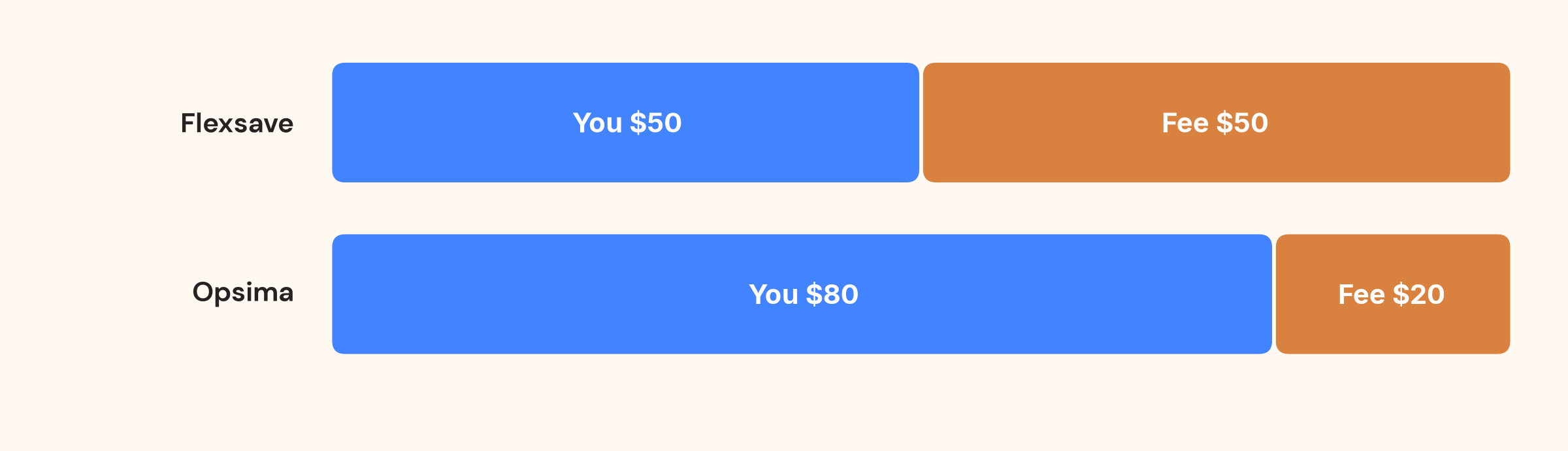
- Savings Share: Opsima only takes 20% of the savings. Flexsave is reported to retain up to 50%.
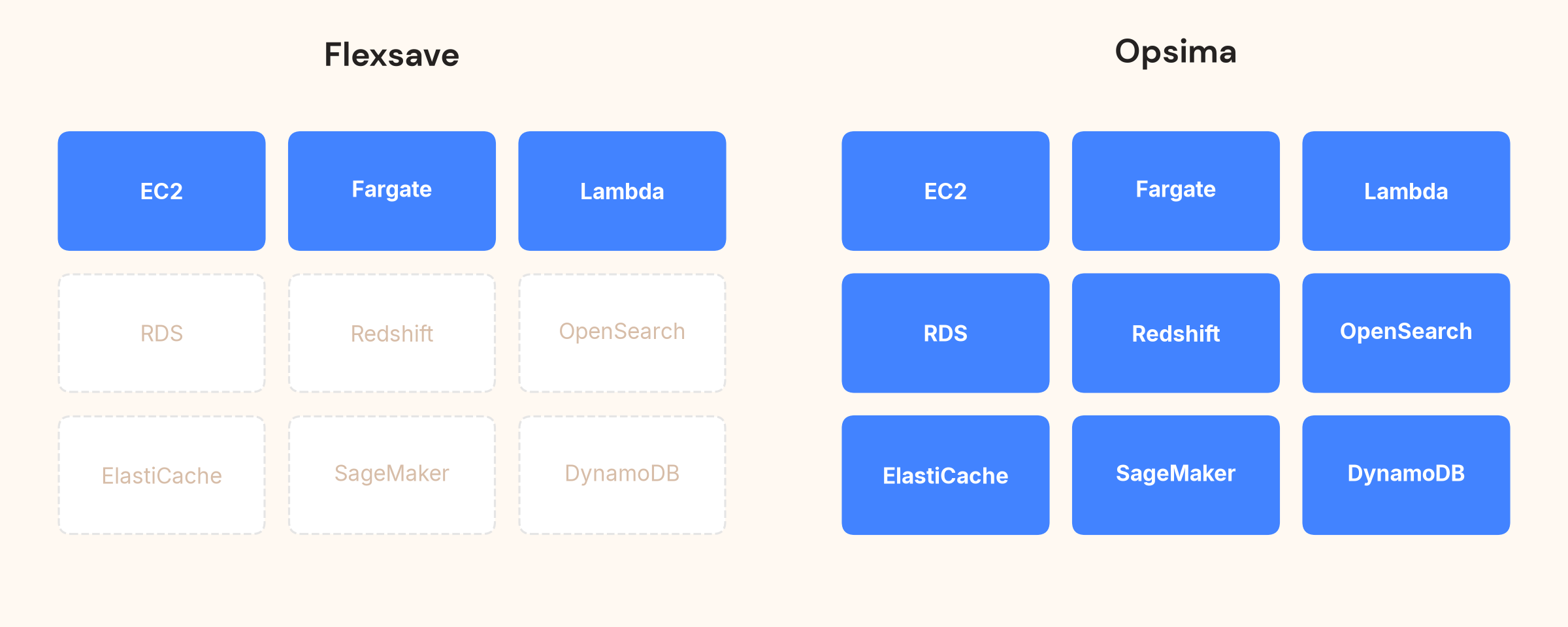
- Scope: Opsima covers a wider range of services, including RDS, OpenSearch, and ElastiCache, while Flexsave focuses primarily on Compute.
- Control of your AWS organization: Opsima requires zero changes to your billing setup, and our fee appears directly on your AWS bill. With Flexsave, you no longer receive invoices from AWS but from DoIT.
- If you are already a DoiT client: Opsima integrates seamlessly alongside Flexsave. This allows you to retain your existing services while using Opsima to fill optimization gaps (like RDS) and maximize your total savings without disruption.
Opsima’s ultimate goal is to provide the most specialized, least invasive platform for maximum financial efficiency and full workload freedom.
The FinOps Landscape: Two Approaches to AWS Commitment Optimization
In the world of FinOps, maximizing cost efficiency on AWS often revolves around strategic management of commitment-based discounts like Reserved Instances (RIs) and Savings Plans (SPs). DoiT is a cloud partner with various offerings, and this comparison focuses specifically on DoiT Flexsave for Compute, as it is their solution aimed at optimizing AWS commitment management. Opsima, on the other hand, provides its own distinct mechanism for achieving the same goal.
DoiT Flexsave generally operates on a commitment reseller model. It leverages DoiT’s pooled RIs/SPs to cover a customer’s eligible on-demand usage, effectively applying a discount without the customer needing to purchase or manage the commitments directly.
Opsima, conversely, acts as a purely automated commitment management layer that works directly within the customer’s AWS billing environment. Opsima’s core value lies in its sophisticated engine that continuously analyses, buys, layers, and switches commitments on the customer’s behalf, supplemented by expert human review, to guarantee the deepest possible savings across a wider range of services.
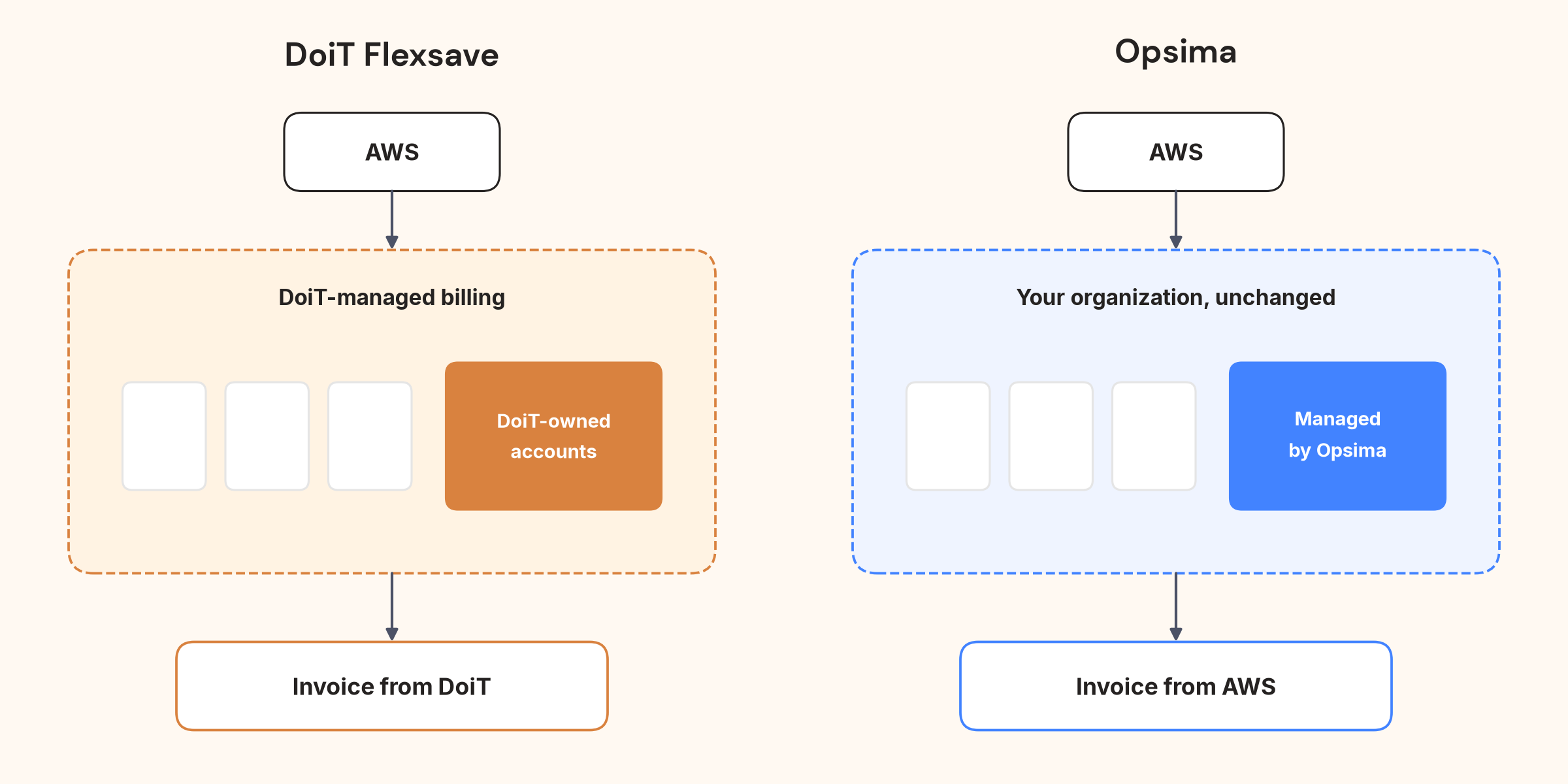
The key difference lies in the mechanism:
The key difference between the two solutions is in three critical areas that impact financial returns and operational scope. Flexsave enables savings primarily for Compute purposes. Opsima, however, provides flexible savings across multiple services (including RDS, OpenSearch, ElastiCache, and more) through automated commitment management and orchestration with expert review.
The primary differentiators are:
- Shared Savings Percentage: The portion of savings retained by the vendor (Flexsave reportedly up to 50% vs. Opsima’s 20%).
- Scope of Coverage: Compute-focused (Flexsave) versus a broader array of commitment-eligible services (Opsima).
- Billing Intermediation: Flexsave often acts as a billing intermediary, handling invoicing and reporting separately, whereas Opsima integrates directly into the existing AWS billing and reporting structure.
Head-to-Head: Opsima vs. DoiT Flexsave for AWS Optimization
| Criteria | DoiT Flexsave (Compute) | Opsima |
|---|---|---|
| Core Mechanism | Automated management of commitments within the customer’s account (like Savings Plans). Primarily focused on Compute coverage. | Automated Commitment Management with expert human review. Predicts usage, layer purchases and manages commitments (RIs/SPs) directly in your AWS organization. |
| Security & Permissions | Requires DoiT as your AWS reseller: your AWS billing moves to DoiT, and DoiT adds its own Flexsave accounts to your organization. | Operates with an IAM Role with limited rights to take and withdraw commitments. Zero access to your production or development environment. No change of AWS Organization/Billing Info. |
| AWS Service Coverage | Focused on Compute (EC2, Fargate, Lambda). | Wider Coverage, including Compute (EC2, Fargate, Lambda), Databases, specific services like SageMaker, RDS, RedShift, OpenSearch, ElastiCache, DynamoDB. |
| Automation | Fully automated. Runs in the background. | Fully automated. Runs in the background. |
| Additional Services (DevOps/Consulting) | Included as part of the broader DoiT offering. | Not applicable. Opsima is a pure player focusing solely on FinOps automation. |
| Financial risk | Zero financial risk to the customer. DoiT manages the commitment inventory risk. | Contractual No-Loss Guarantee. Opsima guarantees savings against the On-Demand price. |
| Pricing Model / Savings Share | Revenue is derived from the margin/discount applied to the commitment resale. A fixed percentage, reportedly 50% of the achieved savings. | Pay-as-you-Save. Opsima takes 20% of actual savings delivered which allows a higher saving share for you. |
| Billing & Accounting | Distinct Invoicing. DoiT provides a separate invoice integrating the savings, adding a new vendor/supplier to your accounting records. | Integrated AWS Invoicing. The Opsima fee/commission is included directly within your existing AWS invoice. No new vendor for your accounting department. |
| Integration with Current FinOps Setup | Designed to be the sole commitment mechanism. | Performs well when it is the sole commitment mechanism. But designed to complement existing setups. Works effectively even on accounts already utilizing Flexsave/other tools for deeper, layered savings. |
| Visibility on Commitments Management, Savings and margins | Limited as commitments are managed externally by DoiT. | High. Full visibility and observability on commitments purchased, layered, and managed within the customer’s account. You have a clear understanding of savings generated by Opsima on a daily basis. |
The Opsima Advantage: Deeper, Broader, and Complementary Savings
While DoiT Flexsave excels at offering a simple, no-commitment approach to basic compute savings for users who prefer a reseller model, Opsima provides a deeper, yet less invasive, layer of FinOps optimization, which is often crucial for maturing organizations:
1. Deeper Savings with a Fairer Share
Flexsave’s business model requires it to take a higher cut of the savings (reportedly 50%) to cover its commitment inventory risk and operational costs.
Opsima takes only 20% of the actual savings. By operating directly on your usage data via an advanced algorithm and minimizing its operational overhead, Opsima delivers the same commitment-based discounts, leaving a much larger percentage of savings (80%) directly in the hands of the customer.
2. No Change to Your AWS Organizational Structure
Flexsave requires the introduction of DoiT-owned accounts into your AWS Organization to act as the commitment holder. This is a significant change to your architecture and billing information.
Opsima is a pure FinOps layer. It connects to your environment only at the billing level. Opsima does not require any change to your AWS Organization structure or billing accounts. This makes its deployment faster, simpler, and less disruptive to your security and compliance teams.
3. Superior Coverage: Beyond Compute
While Flexsave is focused primarily on compute, Opsima’s proprietary algorithm covers a wider range of commitment-eligible services. Most notably, Opsima includes Amazon RDS Reserved Instances, a frequently overlooked area that can yield significant savings for organizations running managed databases.
4. Already a DoIT client? Opsima, a Complementary Strategy
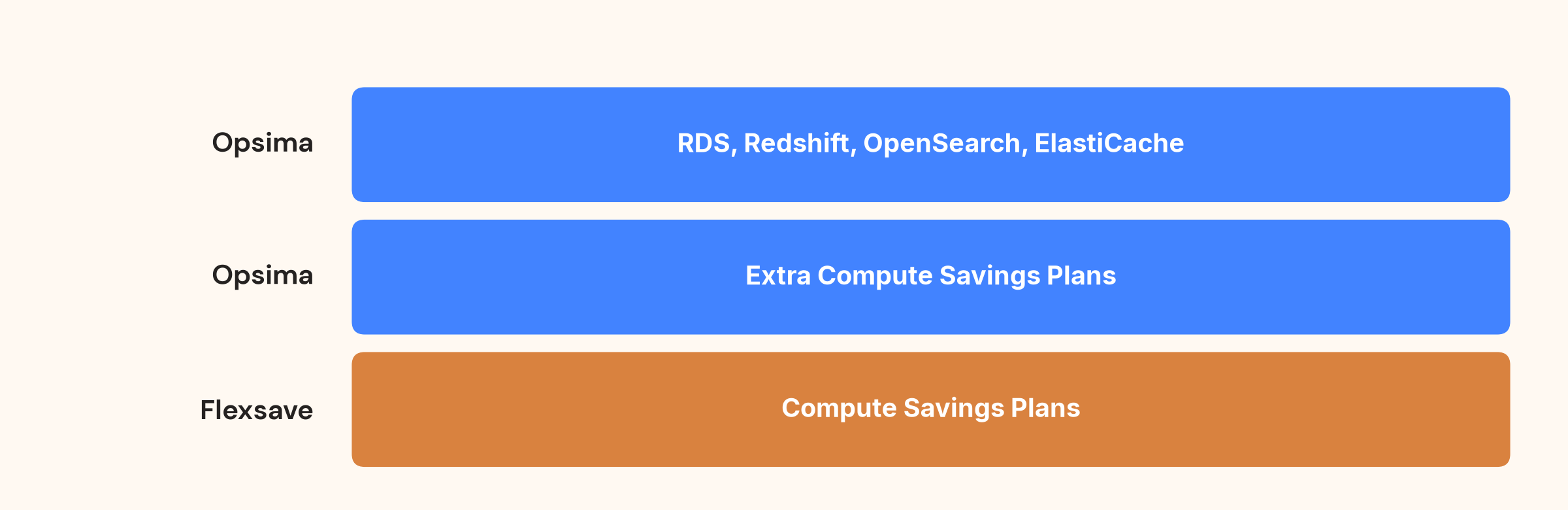
The unique nature of Opsima enables DoIT clients to find more savings that complement Flexsave’s base coverage. In fact, many organizations that use Flexsave install Opsima alongside it:
- Easy integration: Opsima operates with an IAM Role that can be easily created in any DoIT environment.
- Opsima identifies usage Flexsave misses: Flexsave’s coverage is limited to its own commitment pool and scope (Compute). Opsima’s predictive algorithm can purchase RIs/SPs for services like RDS or implement layered strategies that Flexsave’s simpler mechanism overlooks.
- A smooth transition to boost Compute savings: For companies wanting to eventually move away from the reseller model, installing Opsima first allows for a soft transition. Opsima can run in parallel, demonstrating superior savings and efficiency before the decision is made to discontinue Flexsave.
The Verdict: Strategic Fit and Optimization Path
| If Your Priority is… | Choose DoiT Flexsave (only Compute) | DoiT Flexsave + Opsima | Choose Opsima |
|---|---|---|---|
| Utmost Simplicity / No Commitment Management Required |  Yes Yes |
Yes |
Yes (fully automated, no manual management) |
| Compute optimization performance | Savings rate of a 1-year Compute Savings Plan discount |
Savings performed will vary depending on Opsima’s scope of optimization | Higher savings rate from a mix of 3-year and 1-year Savings Plans |
| Optimization of RDS, Redshift, and other RIs |  No (limited to Compute) No (limited to Compute) |
Yes |
Yes |
| Zero Impact on AWS Billing Info | No |
No variation in your current DoIT billing setup |
Yes Opsima’s fee appears on your AWS bill |
| Zero Impact on AWS Organization | No |
Yes Opsima operates with an IAM Role |
Yes Opsima operates with an IAM Role |
| Better visibility and observability on your commitments management | No (black box) |
Visibility on the commitments handled by Opsima only | Yes |
| More optional services like DevOps services | Yes |
Yes |
No |
The Decision: Choosing Your Optimization Strategy
The optimal path depends on your organization’s current FinOps maturity, the services requiring optimization, and your tolerance for organizational change:
If you are starting your commitment optimization journey
DoiT Flexsave is well-suited for organizations prioritizing basic savings only on Compute, accepting a lower percentage of total savings in exchange for a hands-off reseller model focused on core Compute resources. It fits environments that prioritize having a single partner for both cloud optimization and broader advisory/DevOps services.
Opsima is the stronger technical fit for enterprises demanding maximum savings (80%+ share), deeper, broader optimization (including RDS), maximum transparency on their savings share, and no interference or modification of their AWS organizational structure and accounting practices. It is a specialized platform for deep, non-disruptive financial efficiency.
If you are currently a DoiT customer (Flexsave is already in place)
If Flexsave is already managing Compute savings, the company should evaluate the remaining optimization gaps in its environment. The Combined Approach (DoiT + Opsima) is ideal if there is a need to optimize non-Compute services (like RDS, Redshift) or to deploy a more sophisticated commitment strategy to achieve maximum savings across varied usage patterns. Opsima integrates seamlessly with the existing setup, allowing a deeper, specialized automation that identifies and covers areas missed by Flexsave, offering enhanced savings and better control without requiring a change to the existing DoiT relationship.
The choice ultimately comes down to whether you prioritize basic savings and DevOps service offering (DoiT), or a specialized platform for deeper financial efficiency, maximum service coverage, workload freedom, and zero disruption (Opsima).
FAQ
1. Does Opsima require me to change my AWS Organization or Billing Information, like Flexsave?
Absolutely not. This is a fundamental difference. DoiT Flexsave requires integration that affects your AWS organization and involves changes to your billing accounts so that you are billed by DoiT and no longer by AWS. Opsima works solely at the billing and governance level. It integrates via a secure, read-only cross-account role and requires no changes to your AWS organization, billing structure, or existing infrastructure. This means, by adopting Opsima, you will still be billed by AWS if you are on AWS only and not on DoiT, and you will be billed by DoiT if you were previously.
2. Can I use Opsima alongside DoiT Flexsave in my current AWS environment?
Yes, you can. Opsima is designed to be highly complementary. Since Flexsave primarily covers compute usage through its reselling mechanism, Opsima can be installed to manage commitments on services that Flexsave typically does not cover (like Amazon RDS RIs) or to find deeper, layered Savings Plan opportunities that complement Flexsave’s base coverage. Many customers use Opsima during a transitional phase.
3. How does Opsima’s pricing model compare to Flexsave’s shared savings model?
The models are distinct. Flexsave operates on a reseller margin, where they purchase commitments in bulk and resell them at a reduced rate to you, earning revenue from the difference which can be as much as 50% of the savings. But by the side of the client, anything changes because they pay the same exact amount they would have paid with 1 year commitments with AWS. Opsima follows a transparent, pay-as-you-save commission model, charging only 20% of the verified savings achieved. This ensures customers always know exactly what percentage of savings they are retaining.
4. Which solution offers better coverage for my non-compute services like Databases?
Opsima offers broader service coverage. While Flexsave focuses heavily on Compute (EC2, Fargate, Lambda), Opsima’s algorithm is designed to manage commitments across a wider spectrum of services, crucially including Reserved Instances for Amazon RDS and other analytical services that represent significant cost centers for many enterprises.
5. Does Opsima take on the risk of unused Reserved Instances or Savings Plans?
Yes, Opsima fully assumes the financial risk. Opsima’s predictive algorithm is designed to prevent over-commitment. In case of unpredicted changes in usage or infrastructure, Opsima will actively adjust its commitment strategy to maintain utilization. In the extremely rare case of over-commitment, Opsima will refund any loss per its contractual no loss guarantee.
6. What level of AWS permissions does Opsima require?
Opsima requires billing-level permissions only through a secure, non-invasive cross-account role. This is strictly for analyzing usage data and executing commitment purchases/exchanges within the AWS Billing Console. Opsima has zero access to your EC2 instances, S3 data, application code, or infrastructure.
7. If I am already a customer of DoiT, why should I consider implementing Opsima?
You should consider implementing Opsima if you:
- a) require optimization for services not covered by Flexsave (e.g., RDS, OpenSearch, ElastiCache);
- b) aim to retain a larger share of your savings (80% vs. the reported 50% retained by the vendor);
- c) wish to regain full control of your billing data and re-establish a direct relationship with AWS; or
- d) wish to move toward a risk-free, direct automated commitment management approach without the dependency on an external intermediary’s billing structure.
8. What is Opsima’s long-term advantage for a scaling enterprise?
Opsima’s advantage lies in its automated commitment management system with human review. Unlike reseller models that rely on inventory pools, Opsima uses complex data modeling and layering logic to adapt to highly variable cloud consumption patterns, ensuring sustained, deep optimization as your infrastructure scales and evolves.